
Greetings and salutations, everyone; yes, once again it is I, Mani the purebred border collie, filling in for the guy I live with, and here today to talk about frozen soil. You may remember me from such posts as “Still Not Much Happening”, among so many, many others.
Here I am in a characteristic pose.
 I’m checking for frozen soil here. It’s frozen. Not very deeply, but the top is frozen.
The guy I live with is against frozen soil.
This soil is frozen:
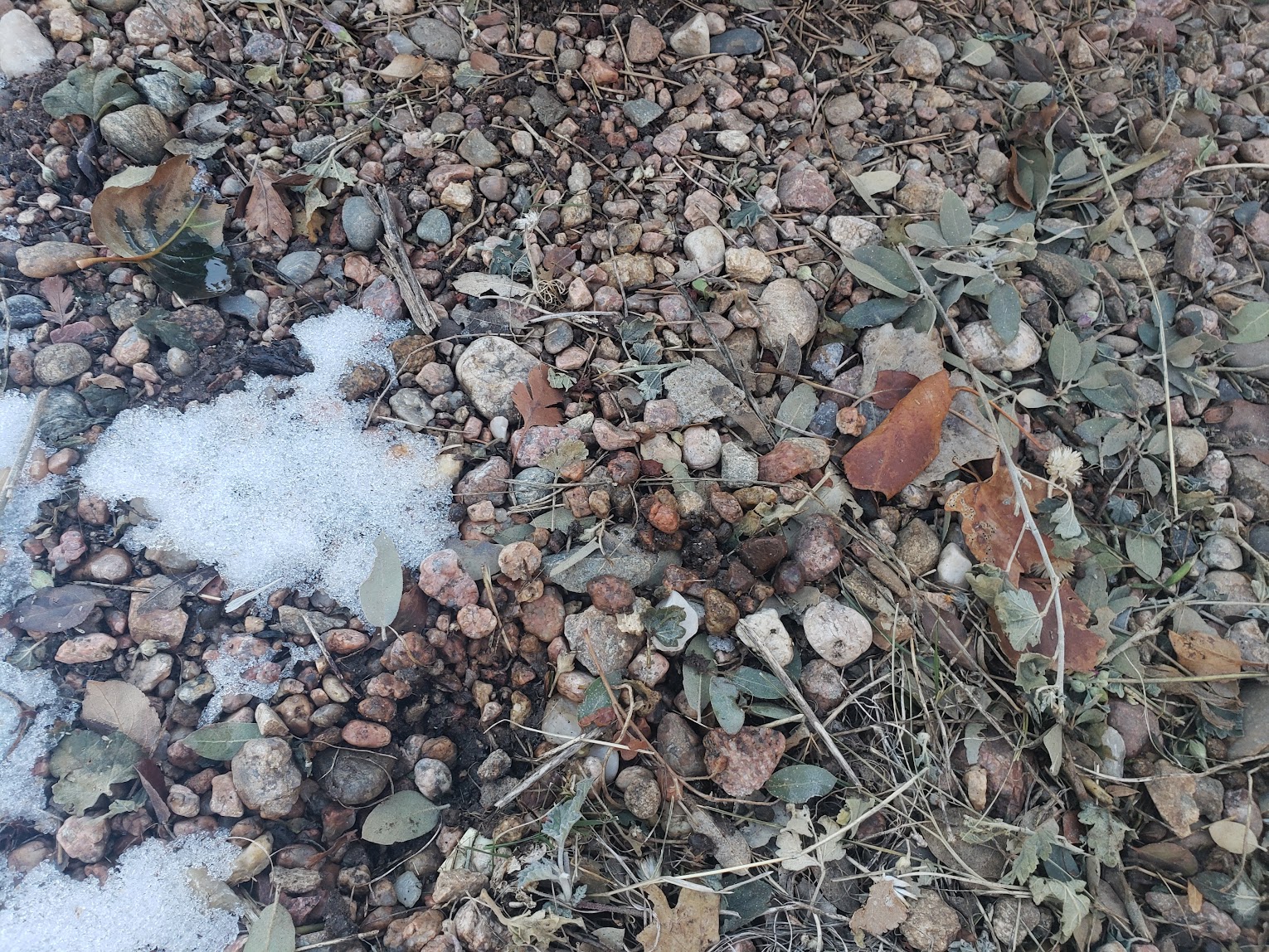 So is this:
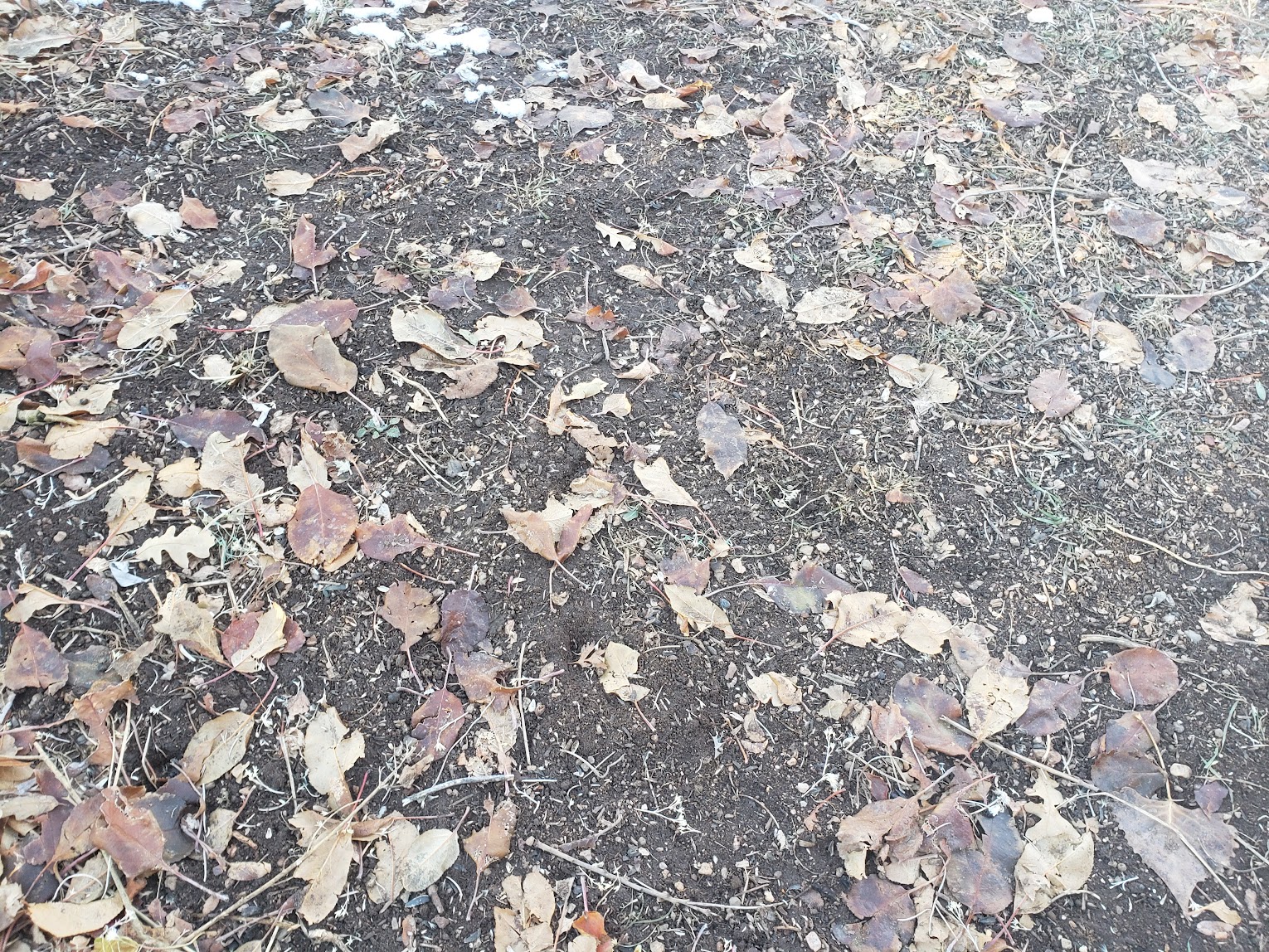 You may notice that the first picture has rock mulch.
The guy I live with says that in semi-arid climates rock mulch is the only type of mulch that allows water to infiltrate into the soil in the summer, unless you water a lot.
But it doesn’t keep the soil from freezing when snow melts into it. Maybe if it were really deep it would.
Some people say that rock mulch generates a lot of heat in the summer, which would probably be true if there were acres of it.
Frozen soil makes it difficult for some plants, like cyclamen, to keep their leaves hydrated during the winter, which is why the guy I live with piled pine needles around the cyclamen before the first time it snowed here. The cyclamen, like autumn-flowering crocuses and of course snowdrops, need their leaves to photosynthesize.
Other plants don’t care. This is a dwarf limber pine (Pinus flexilis) from Jerry Morris:
 It’s not growing, it’s just sitting there. Hardy conifers don’t photosynthesize after a night below freezing, which sounds like a smart move if you ask me.
He’s certainly not going to water this in winter, even though people insist he should. Watering conifers during warm periods can cause them to deacclimate and then get damaged or killed by any cold weather that follows.
(This information comes from a book called Conifer Cold Hardiness.)
The limber pine could also be grown in a pot all winter here, because the roots are hardy to -79 degrees F (-61.6C). Thank goodness it will never get that cold here, but you can see how hardy limber pines really are, because the roots of a woody plant are generally the least hardy part of the plant, besides maybe some of the buds.
This soil is not frozen:
 In spring the guy I live with will take his quiet Ego leaf blower and gently blow all these leaves across the path into this garden, where the soil also isn’t frozen:
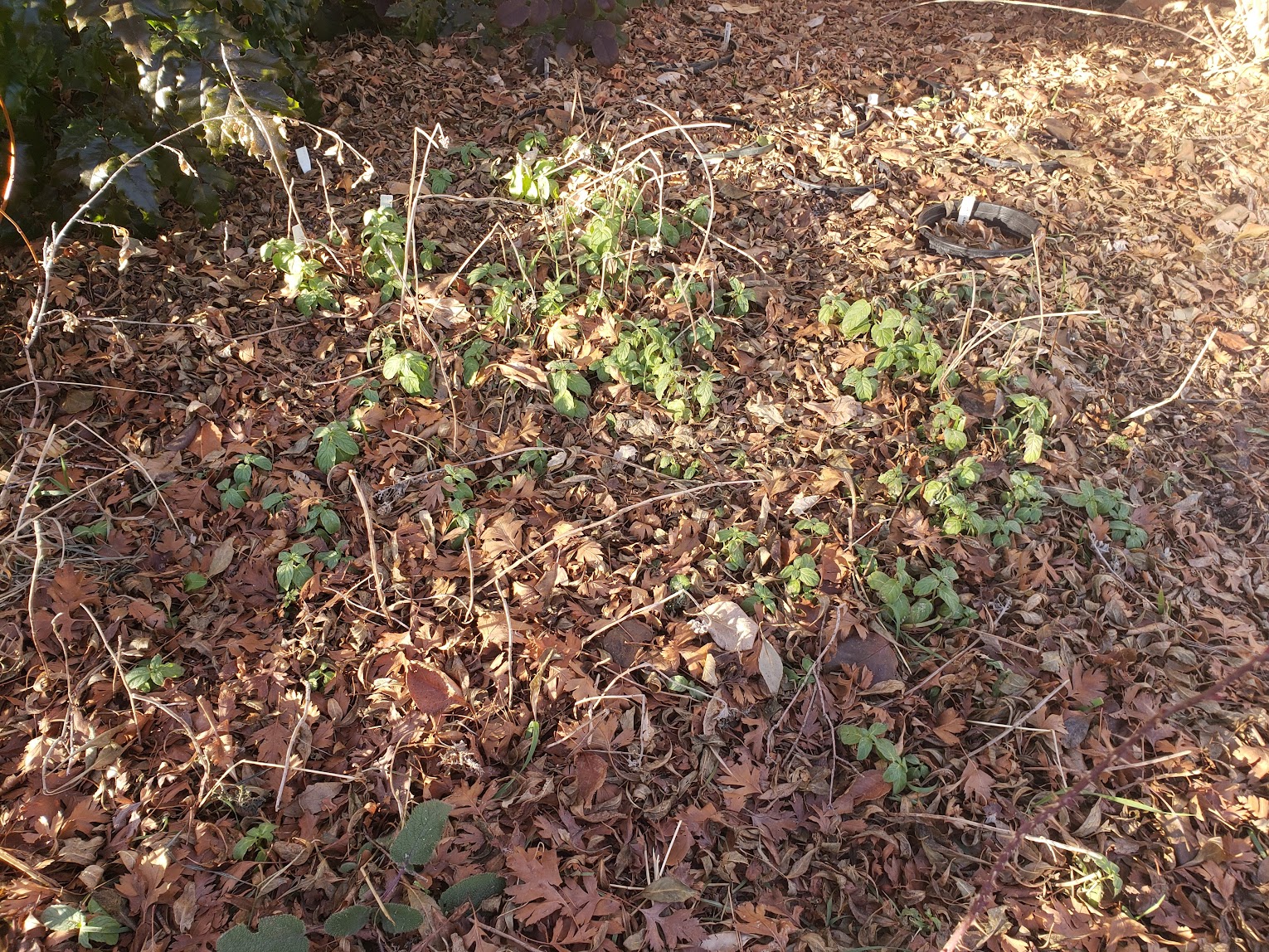 If we get a huge amount of snow later in the winter, which is possible, then maybe the melting snow will infiltrate through the leaves and, if it gets cold after that, the soil will freeze, but probably not the soil in the bottom picture.
There are snowdrops in those pots, and some of them are up, as I showed in my last post.
All those little leaves are from the ‘Himalayan Silver’ mint.
The guy I live with used to take all the old Christmas trees from the neighbors and cut them up and lay the branches over parts of the garden, but then later he was left with all these branches.
And that’s all I have for today. I didn’t feel like walking down the creek this evening, so we didn’t see that willow.
I hope you found this more fascinating than I did.

Until next time, then.

 the miserable gardener
That conifer book sounds interesting. I didn’t know about the risk of winter-watering conifers.
The guy I live with says the book is fantastically expensive, but it’s also on Google Books.
Cold-hardy conifers have evolved to tolerate frozen soil, occasional warm spells, and so on.
Damage from cold winters usually results from the conifers being insufficiently hydrated prior to the onset of winter.
First stage of preparation for winter hardiness is day length.Or night length.At that point the entire conifer needs to be fully hydrated, with rain, snow, or watering. The water is used to manufacture “antifreeze”. Second stage, nights below freezing. (Third stage is nights below about -30F but we don’t see that here.)
Thank you. Never learned this from the extension service. Boy, I bet this can cause some lively discussions. It’s fascinating and I appreciate the further explanation.
The guy I live with says “lively discussions” are an understatement.
Since he’s not an “influencer” he doesn’t get into this stuff very much; it’s just that he doesn’t do this and has never noticed anything bad happening, anywhere.
The most important thing is to make sure non-native woody plants, and native conifers, are fully hydrstaed before it gets cold.
And that some broadleaf evergreens benefit from non-frozen soil. He bought some hollies on sale, planted them, the soil froze, the leaves couldn’t pull water from the soil and withered, and the hollies died. Just like that.
Thinking about the long-neglected property we bought several years ago, the nine (now eight) mature spruces have done well for probably 50 years. (The one spruce was removed because it had been topped by a previous owner and the topping caused dieback). Their health in spite of neglect (dead lawn and garden areas) had got me to pondering this subject.
I do make sure to water well in the fall.
Thanks again to the (non-influencer) guy you live with, Mani.
You’re welcome.
The guy I live with says it’s unusual to see spruces tolerate a lot of drought, but then you never know. They’re pretty shallow-rooted and sometimes large ones get knocked over by high winds here. The roots, though are hardy to at least -100 degrees F.
(The roots of a tree like saucer magnolia, Magnolia soulangeana, are only hardy to +25F, but they’re inulsated by soil.)
You’ll find sites that say conifers don’t absorb water through their needles, but really, they do. The guy I live with thinks that watering the roots and needles of newly-planted conifers is very important, at least until it gets cold.
I too, found that info about conifer watering fascinating and quite interesting. I had no idea. Around the metro area, ‘people in the know’ say you should water trees during times of drought although they’re all deciduous trees, not evergreens.
The guy I live with says this is something that makes people absolutely livid. There used to be a mailing list devoted to gardening here, and every time people would go on about “winter watering” the guy I live with would ask for proof that dormant trees all over the Front Range die because they aren’t watered. People would get furious with him. He would tell them that he drove around south Denver for fifteen years and never saw anyone watering, yet there weren’t hundreds of dead trees, which wouldn’t be hard to notice.
Eventually he got sick of this and offered a garden tour where no watering in winter had ever been done. People came, and said, “But still…”. But still what? Where are the dead trees?
He even got into arguments with professionals, who used trees in California as examples.
There are millions of deciduous trees in the Denver metro area, no one waters them, and they’re fine. Because they’re dormant.
“But roots grow when soil temperatures reach 40 degrees.” Yes, they do. But the next day after you’ve watered, and the temperature is now 15 degrees, the way it can be here, the soil is now frozen and no roots are going to grow.
I think you can see how this goes.
The guy I live with says the best path, for him, is just to ignore all of this and do what he does, which is nothing. It’s certainly a lot easier than doing something.
Even snowdrops, which are in active growth all winter, don’t need watering.
This makes sense to me. 🙏
All you really have to do is look around and see how many trees have died after a dry winter. Usually none.
Makes total sense. I think trees that die have other issues and during times of drought, people extrapolate the reason for their demise.
That’s exactly right. Lack of water during the growing season can reveal itself the next year, or the year after.
But newly-planted trees and shrubs do need plenty of water before it gets cold. The water helps make the “antifreeze”. What the late Jerry Morris called “the pump”, roots pull water and the tree pumps it to the branches and twigs.
Your weather reminds me to appreciate the weather here. Frozen soil is just too cold. I doubt that Rhody would like it either. I would brag about how mild the weather here is, but a tornado just went over on Saturday, and landed right on Target, . . . literally. It landed at the Target store in Scotts Valley, less than two miles away. Otherwise, our weather is pretty chill, . . . but without too much chill.
We heard about the tornado.
Rhody heard about Toto, and he wants none of that.
That littel Pine tree iss furry cute! But you are cuter Mani!!! ***nose bopss*** BellaDharma an ((hugss)) BellaSita Mum