
Greetings and salutations, everyone; yes, once again it is I, Mani the purebred border collie, filling in for the guy I live with, and here today with something a little different.
You may remember me from such posts as “A Nice Day”, among so many, many others.
Here I am in a characteristic pose. 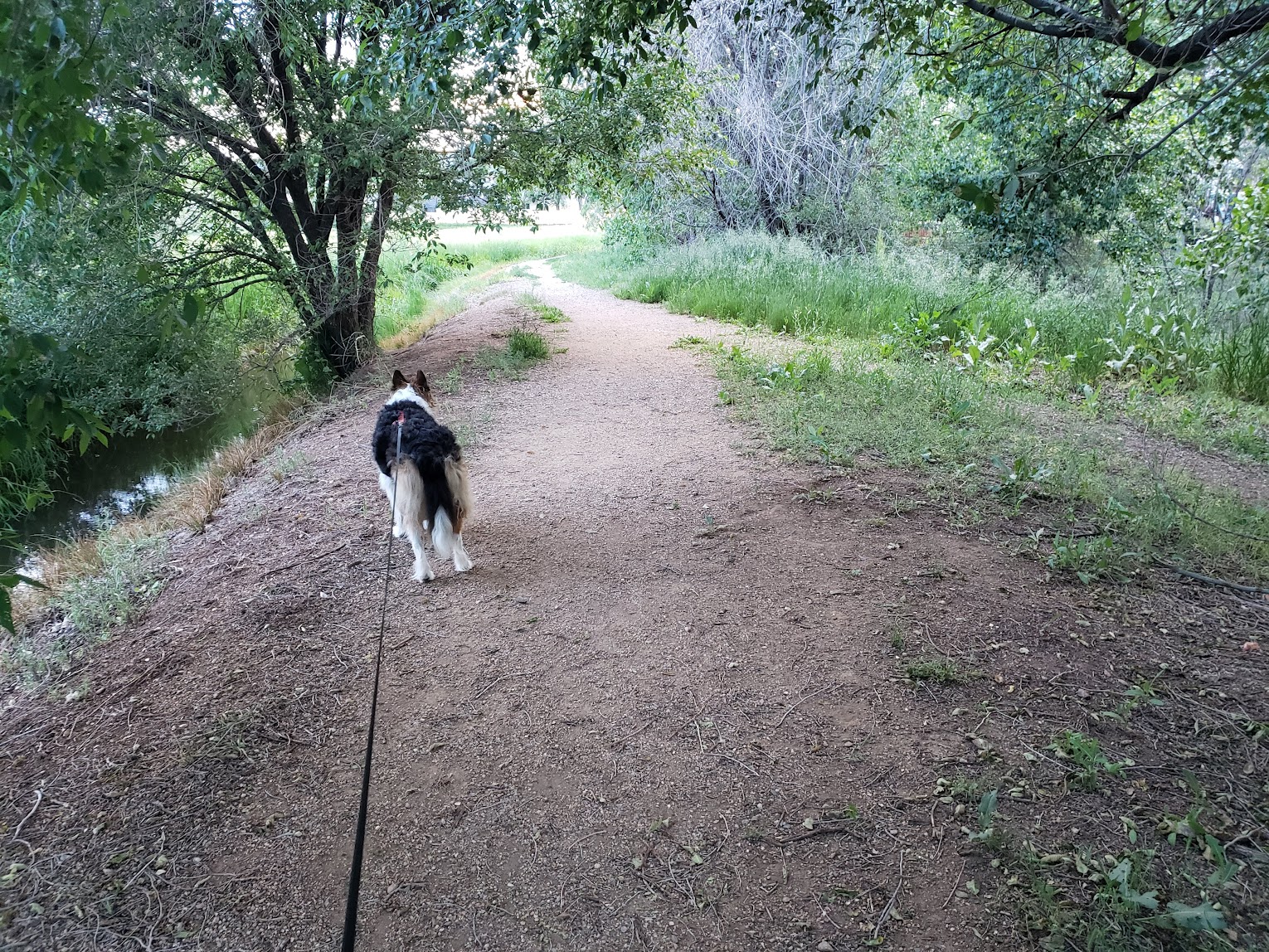 I’m making sure no dogs are coming toward me, and so nobly protecting the guy I live with.
The green belt is flowering. It’s a golden yellow belt now.
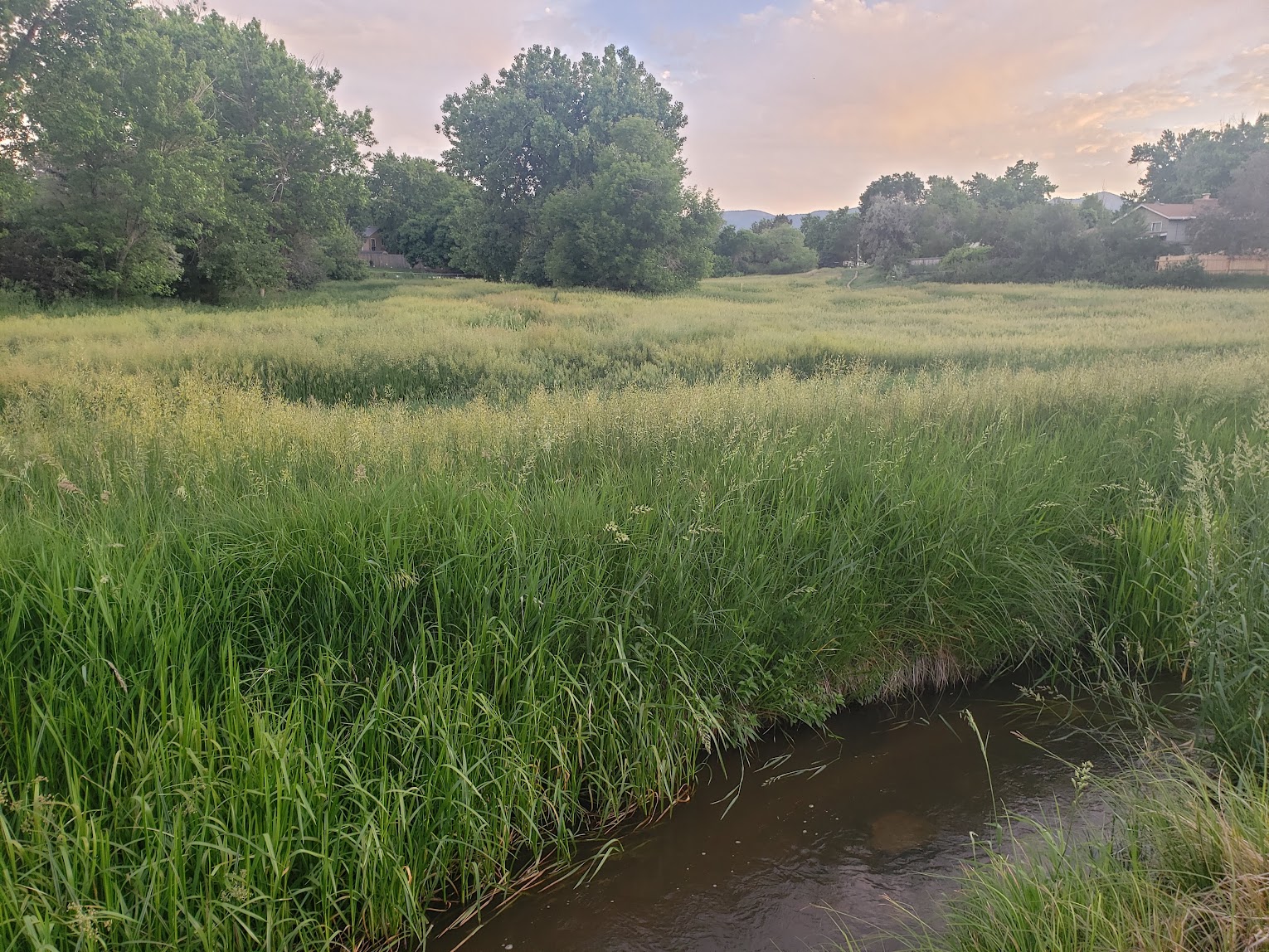 I got covered with grass flowers on my walk this evening.
This morning or yesterday morning we went to look at the prickly poppies in flower.
Argemone platyacanthos.
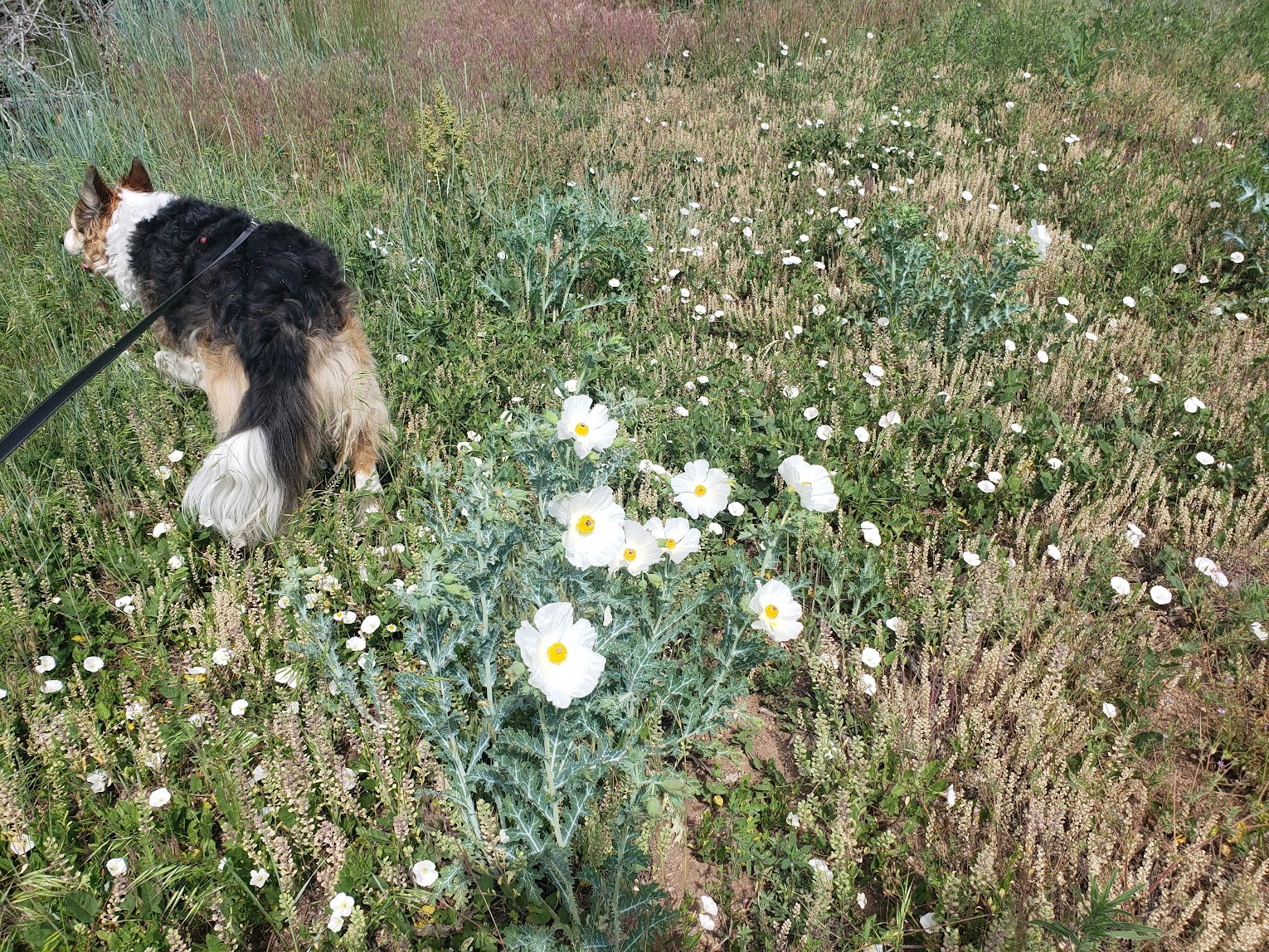 The rest of the pictures were posted on Facebook, but here they are again.
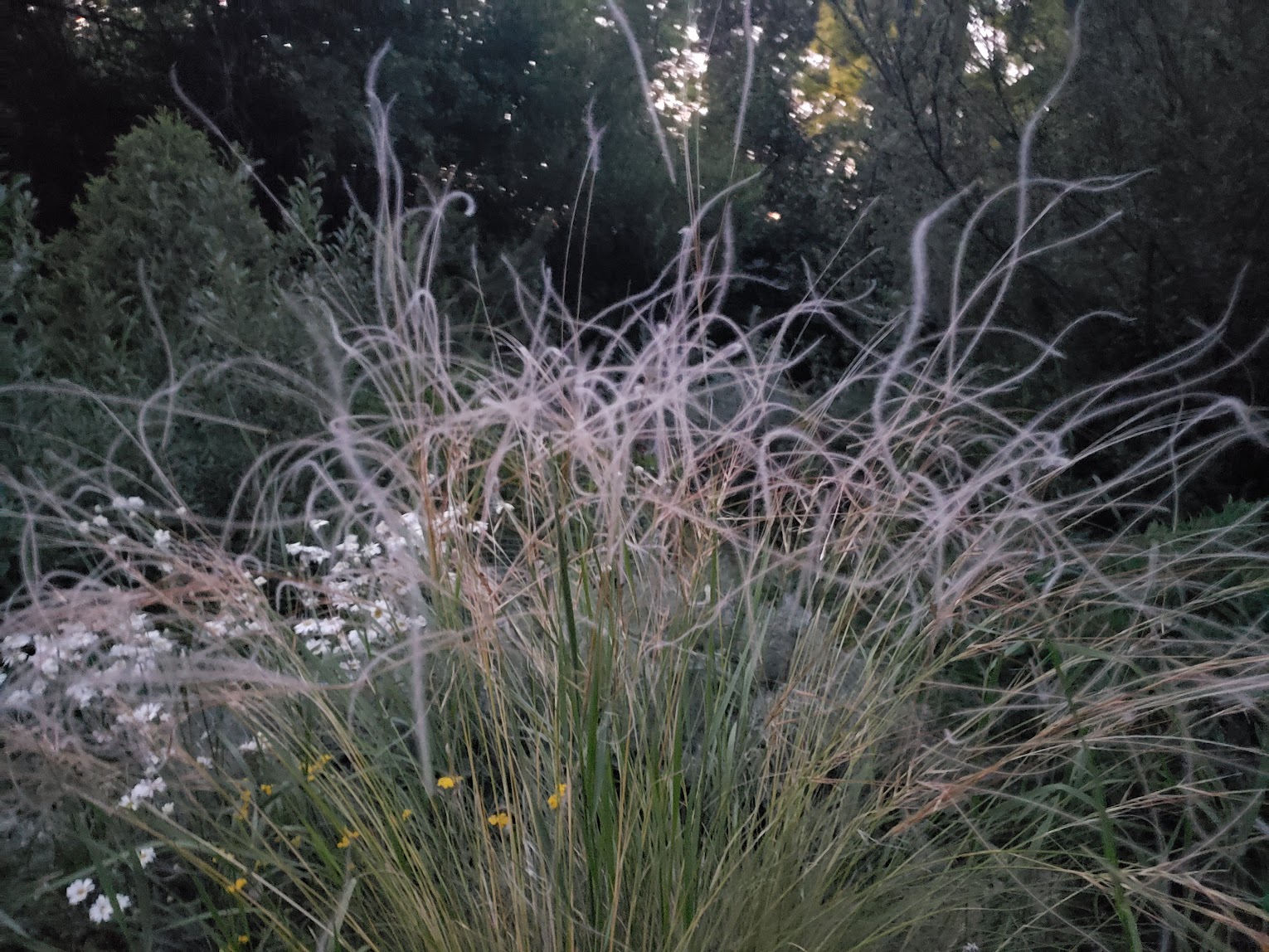
This is Stipa ucrainica; the picture was taken at twilight.
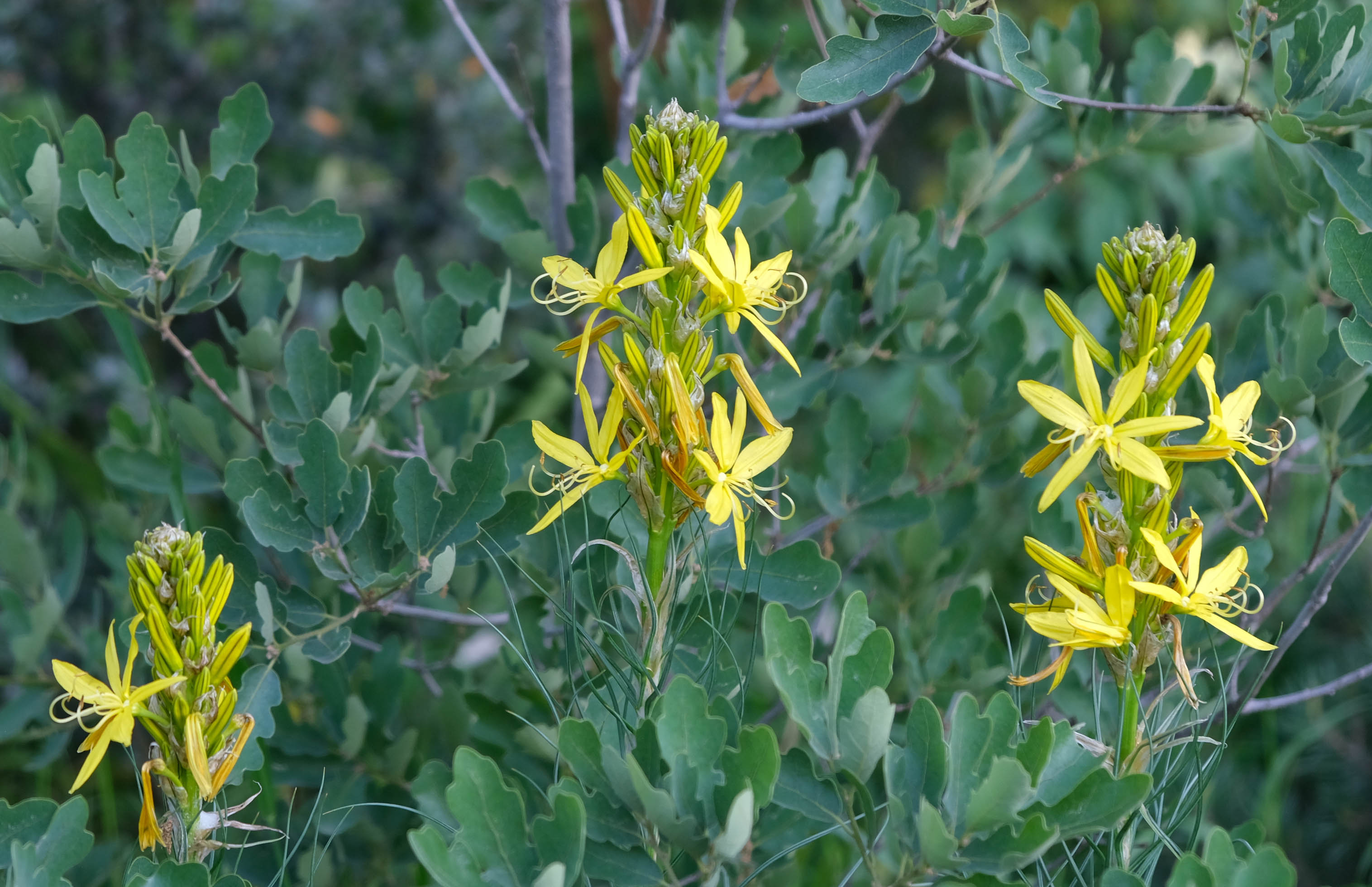
 Asphodeline lutea coming up through a dwarf oak the guy I live with got from the late Jerry Morris:
 The flowering stalk on Yucca reverchonii:
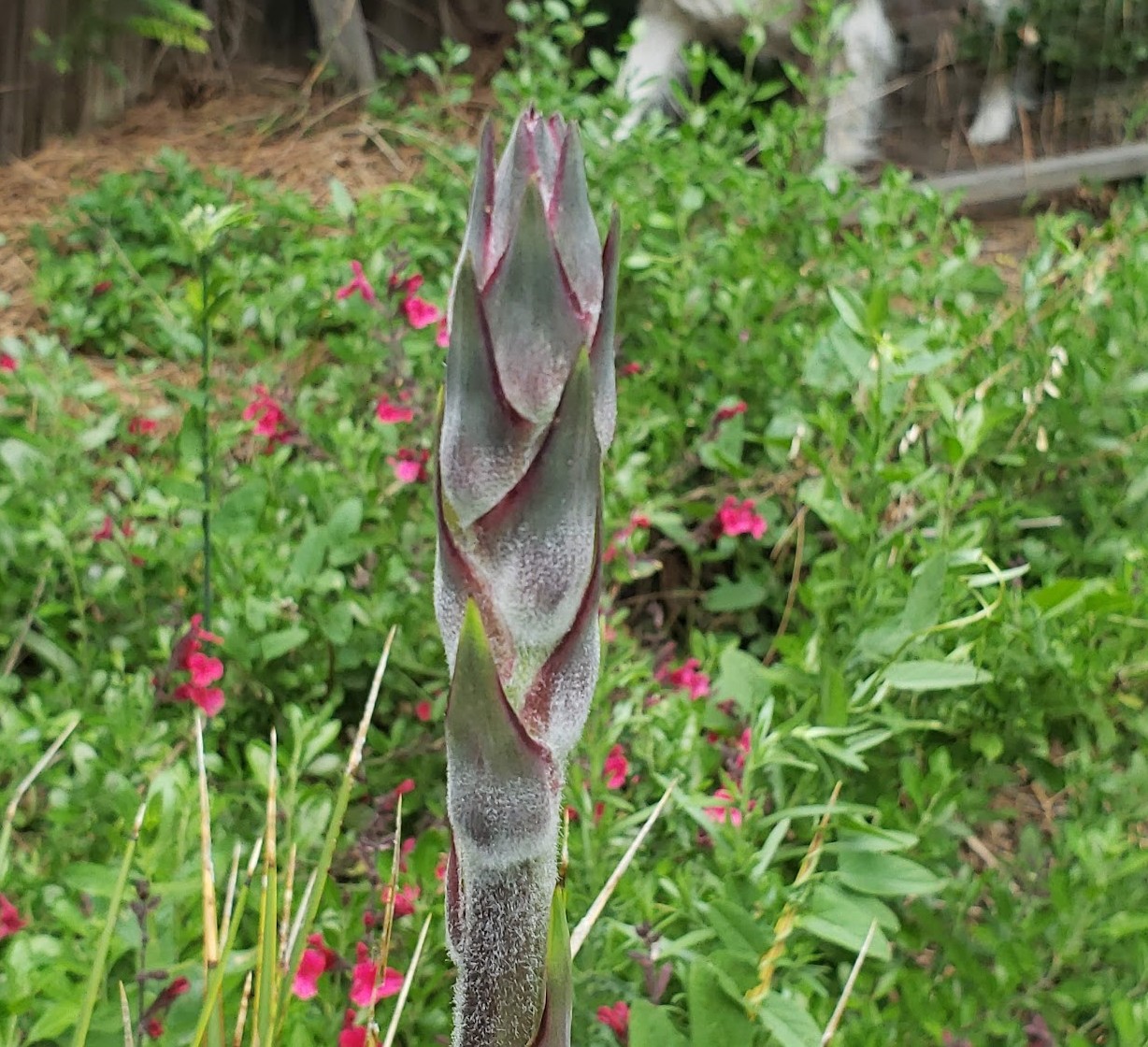 The guy I live with said “someone photobombed this picture”.
And the first calochortus. This is Calochortus venustus.
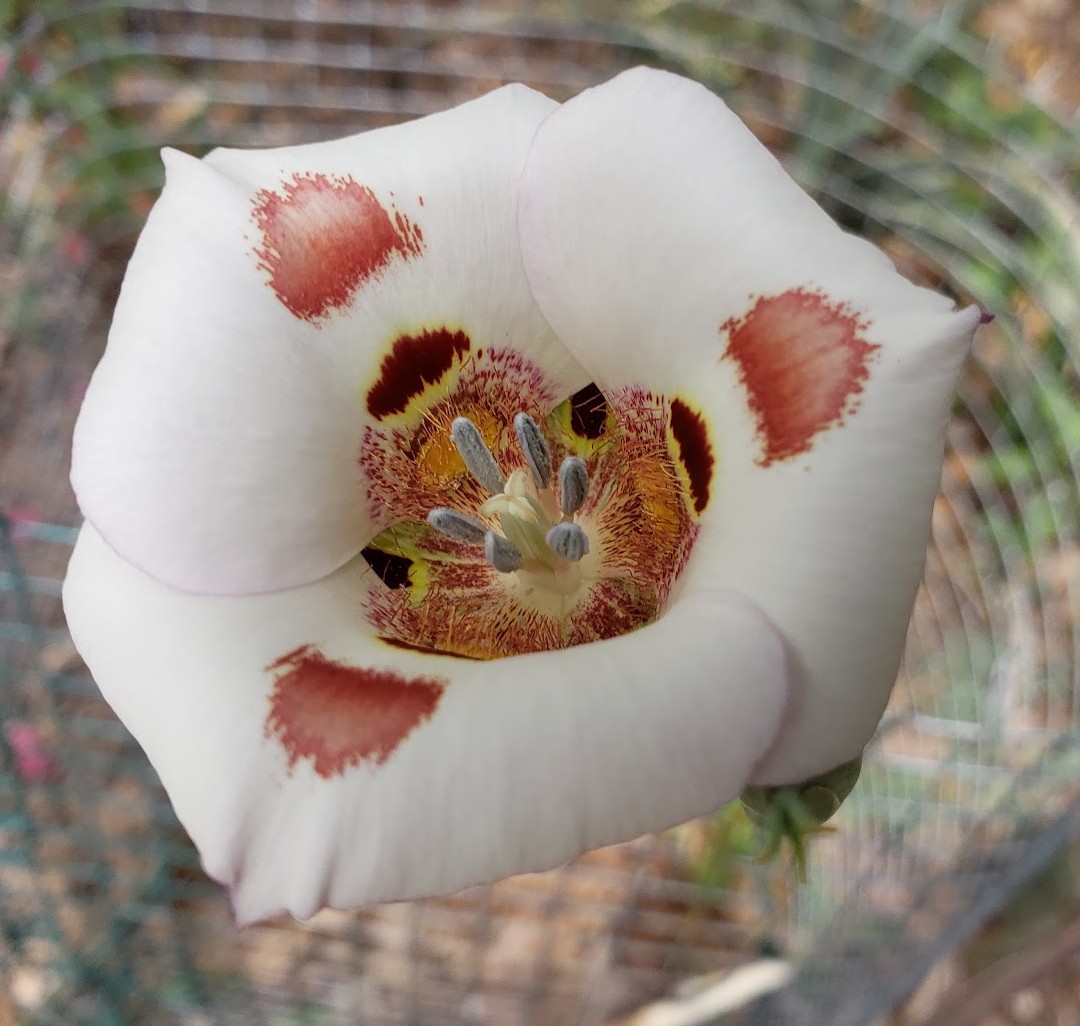 It’s in a cage to protect it from being eaten by rabbits, which kills the bulbs because they can’t photosynthesize.
There are some other calochortus which may flower here soon.
Most of the guy I live with’s attempts to grow calochortuses have been complete failures. Every so often one will appear, the guy I live with will get all excited, and then we don’t see them for years.
But maybe it’s because we’ve had so much rain that we’re seeing them again.
One other thing. The guy I live with says yes this is native to California, but that doesn’t mean anything about its hardiness if the leaves don’t emerge so soon that they get frozen (same effect as being eaten by rabbits) or there are no overwintering leaves and the species hasn’t evolved to manufacture cryoprotective sugars (“antifreeze”).
Like snowdrops have overwintering leaves but they manufacture antifreeze, so they’re fine.
Calochortus come up, flower, and then die down. No issues.
If it gets really cold, and it certainly does here, the bulbs are insulated because they’re in the ground, and if the soil freezes here, it doesn’t freeze very deeply.
Now that it’s getting warmer and raining less, the talk is turning to penstemons, and the guy I live with posted this didactic picture of a semi-dissected flower. He used the phone camera for this, which maybe you’ll agree is pretty impressive.
This shows how to identify a penstemon.
First, you need to know where you are. Like you would never see this species in Colorado.
Second, you need to look at the basal and stem leaves.
Third, the inflorescence, whether it’s in a whorl, or secund (flowers on just one side of the flowering stalk), and so on.
And fourth, you need to look at the anthers and the sterile staminode.
We’ll just look at the flower here.
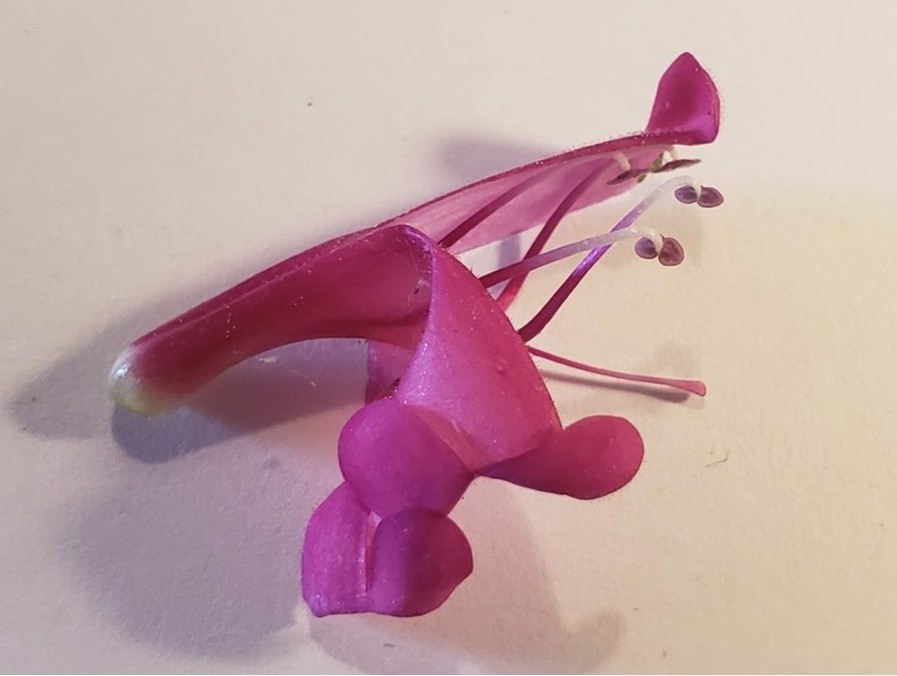 You can see the little hairs on the corolla. The anthers, the little brown things, are peltate-explanate (from the Latin pelta, a little shield; you can see how it looks sort of like a Roman centurion holding a small flat–explanate–shield).
This puts this in Section Peltanthera. Other species in this section are Penstemon palmeri, which I showed last time; P. clutei and P. parryi from Arizona; P. grinnelli, P. clevelandii, P.centranthifolius, and P. spectabilis from California.
And quite a few less well-known species.
The rose-red corolla and its shape makes this Penstemon pseudospectabilis, from Nevada, Arizona, and New Mexico.
But here’s an odd thing. Take a look at the staminode, the thing sort of hanging down. No beard. The subspecies with a bearded staminode is subsp. connatifolius, the most common subspecies (probably now considered just variety); the term connate means leaves clasping the stem.
So this is subspecies (or variety) pseudospectabilis, which is the rarer of the two, and yet this is the one common in the nursery trade.
Whew, huh. I’ve learned a lot about penstemons, don’t you think?
For years the guy I live with had issues with people asking for identification of penstemons, like ones they’ve seen on hikes, and so on. It brought up too many memories of him and his wife working on books, but now I guess he’s okay with it.
Well, that’s all I have for today. I hope the penstemon business wasn’t too much
Until next time, then.

 the miserable gardener
Yucca reverchonii is San Angelo yucca! That is rare, and totally awesome! Calochortus venustus is one of a few species of the genus that grew wild where I went to school in San Luis Obispo. I did not realize how uncommon it is back then. Both of these genera are as interesting as Penstemon.
Yep. The guy I live with, though, is kind of irritated that he paid attention to nursery catalogs and garden writers when it came to calochortus. And that he was such a failure growing them from seed. Easy to germinate with stratification, difficult to keep after that.
Well, he tried, which is more than most of us do. I would be inclined to ‘borrow’ calochortus from the wild, which would not work.
The guy I live with said they did that, back in the old days of Carl Purdy. He read that Purdy shipped dug-up calochortus bulbs to a nursery in New England (totally the wrong climate) and they were no doubt sent to even less calochortus-friendly climates.
It was common thing to do, amnd there was no stigma against it.
Oh, I am not so concerned about stigma. I just know how difficult it is for some of the native perennials to survive relocation from the wild. Calochortus bulbs are not easy to dig from the wild anyway. They are very deep within rocky soil.
Well it was certainly done back in the old days. It’s still done, with cactus, in Mexico and maybe this country. Cactus poachers.
Oh yes, and Joshua tree poachers.
True.
I needn’t have gone past the Argemone – I love it!
It’s a beautiful plant, but very unfriendly. You can see a couple more a little bit farther away.
This weed-choked field gets mowed, but the argemones reappear every year, in greater quantities. Maybe they immediately ripen their seeds when mowed down.
Beauty at a distance then. It remains a lovely plant.
They are very beautiful. Ruderal “weeds” here.
The guy I live with has had them in the front garden but they never reseeded, or the seedlings were eaten by our resident rabbit.
That was a good Penstemon class, Mani. I am learning a lot from the guy you live with’s book, too. I guess I am starting to collect Penstemons since I’m up to, I think, eight species now, which is nothing (but not bad for my small garden).
That’s a new Yucca for me. From what I just read, it’s kind of rare. Nice!
Thanks. Penstemons are pretty easy to grow from seeds just sown outdoors in pots in say November.
The guy I live with kind of ignored the yucca for years, but now it’ll be hard to ignore.
Mee-yow so much inntersting flowerss an plantss Mani an Guy!!! May wee ask iss THE Calochortus a type of Poppy? Sorry, wee not well veresed inn Flower knowledge! Wee DUE nose wee LOVE Calochortus flowers! An how kewl about Penstemones….wee reelly new nothin about them…Thanx fore educatin us Mani!! Wee love yore 2 fotoss two!
***nose bopss*** BellaDharma an ((hugss)) BellaSita Mum
Thanks, and you’re welcome.
Calochortus are in the lily family. Most species are from California, and most are adapted to very dry summers, which the guy I live with said we can provide without getting out of bed in the morning.
We love penstemons, Mani and your shared specimens are most lovely. That golden green belt will likely be a whole lot less golden or green by next weekend after a forecast of mid to high 90’s. We’re already counting down the days until autumn official arrives (‘only’ 99 to go) since neither Mum or me enjoy the heat. Stay cool.
Your fur-iend,
Wilson 🐾
Thanks.
The guy I live with says that since the grass is smooth brome it may not be affected by the heat.
Hopefully we’ll get a thunderstorm or two, but that’s not so likely with the weather moving west to east now. The storms skip over our garden and wind up out on the plains.
The calochortus is quite stunning so even if you only get one occasionally it’s still worth it. I do love penstemon. The dissection and explanation of the blossom is quite interesting. I grow a lot of different penstemons here too. They’re great in dry areas.
The guy I live with said he’d like to have more calochortus. Well of course.
Penstemons are super easy from seed and the guy I live with had about a dozen pots of healthy seedlings in the frames as winter set in. He said there would be no problem, but this spring he went to look and they were all gone.
There was a mouse nest in the frame. He said it was easy to make the connection.
Here’s something cool Manny. When I google “Stipa ucrainica”, this blog post comes up on the “Pictures” tab! Not high up but still. Tell your guy.
Also, I’m did ask your guy with help on a Penstemon ID last year… I hate that it may have made him sad. But his answer was much appreciated…. It does seem to be a year for incredible Penstemon displays here in Colorado!
The guy I live with says if you do a search for images of “Mani the purebred border collie”, guess who comes up?
He said you’ll also notice quite a bit of content has been, oh let’s say, “borrowed”.
It was okay about the penstemon identification.
You may find this funny. It’s going to be super hot here this weekend, right? There’s an article online that says we’ll get “moderate humidity”. The guy I live with just laughed. Like since when is it humid here when it’s 99 degrees?
Like never.