
I had to rush to the nursery today (Timberline) because it seemed like the right thing to do. Somehow, it always does. If you don’t count the whole flat of desperately needed silver bluestem (Andropogon saccharoides, or Bothriochloa laguroides ssp. torreyana if you have nothing better to do than type out long new botanical names), I didn’t get very many plants.
Picked up three Festuca punctoria, aptly named as prickly fescue, because I like it and thought the rock garden would look nice with more. The one (or ones, I forget) I grow is on a south-facing raised bed, and suddenly I found myself wondering if I was doing the right thing growing them there.

Trying to find accurate information about plants is less easy than it should be. Wading through a bunch of obvious nonsense, I finally discovered a Turkish website, fortunately not in Turkish, that listed the prickly fescue as an endemic of Uludag, along with some alpine plants I’ve grown in the past, like Arabis drabiformis. The website did not specifically say that the fescue was an alpine plant; for all I know it could grow on the lower slopes and still be endemic.
Uludag is a mountain in western Turkey, the ancient Olympus of the region of Mysia. The Greeks apparently named every snow-capped mountain they saw “Olympus”, which must have been very confusing when asking directions. There are a lot of plants that bear the specific epithet olympica whose Olympus is not the one in Greece. Like lambs’ ears, Stachys byzantina, used to be called Stachys olympica, but not the Olympus, another one, the Bithynian one. Or Aquilegia olympica, also not the Olympus, also not the lambs’ ears one, but the one in the Caucasus.
I’ll plant these on my own Olympus along with other spiked things like acantholimons.
Also acquired were some Teucrium hyrcanicum ‘Purple Tails’. For once a name that tells you what to expect: purple tails. And, in this case, the specific epithet tells you where the plant is from, with not too much equivocation.
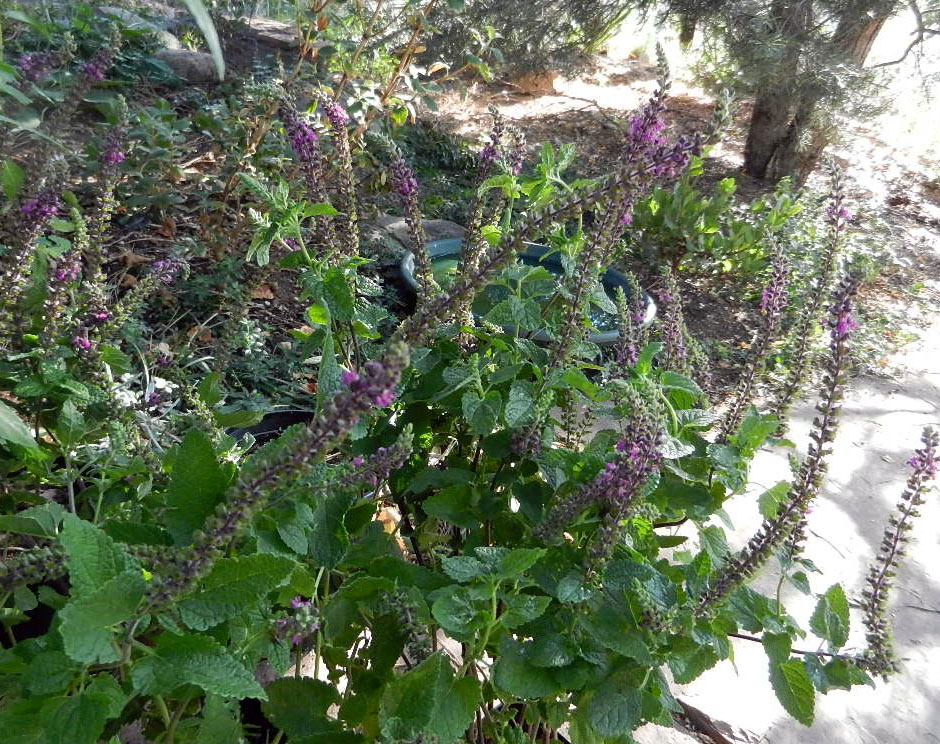
purple tails, almost done wagging
If you read a lot of Latin and Greek like I did (yes, I was a dork in high school), you read about Hyrcania, the region north of the Elburz Mountains in present-day Iran, and bordering the south shore of the Caspian Sea. Not, I think, the driest part of the world, and also not too cold. The drought tolerance of the plant is therefore suspect. Its leaves look an awful lot like “shade leaves” to me. But the purple tails …..
These will have a place too; not quite Hyrcanian, and definitely not Olympian, in the garden that used to be called “The Enclosure” (because it’s enclosed), but now I call it Cindy’s Garden. She built it and planted it. Watered once a week, and now with purple tails.

 the miserable gardener