Somewhere, back in the memory vaults for about 1960, I can see a shrub that my maternal grandfather planted in his garden (oddly, the only thing I ever remember him planting), one that he called “yesterday, today, and tomorrow” because the flowers of the day before remained on the plant, which I now know was Brunfelsia pauciflora. Of course no flowers of tomorrow could exist today, so really there are flowers of three different colors, white changing to pale violet, changing to purple, as the flowers age.
I see this in my mind’s eye and feel anxiety associated with it, because my parents were planning to move away, away from this garden. The garden and the house were a model of how I wanted my life to turn out; an older house, smelling of old furniture and books, where I could sit and spend time reading or poring over maps of places I’d never visit, and a garden full of mysterious dark corners, and, elsewhere, plants nodding in the rainless sun-drenched summers of Los Angeles. My grandfather was retired and I thought the whole thing was idyllic. It was probably anything but.
My grandfather was a military doctor and was with MacArthur in New Guinea and the Philippines. He never talked about his experience. When my father suffered a massive head wound at the Punchbowl in Korea in 1952 the Army doctors told my mother he was going to be a vegetable, but my father recovered, actually making medical history. He was paralyzed on his right side, had expressive aphasia, and violent seizures for the rest of his life. My parents moved to California to be close to my mother’s parents. Looking back on this now, reading the letters between my two grandfathers (my paternal grandfather retired a major general), talking with appalling frankness, and at the same time hope, it seems clear that a life I saw as perfect was probably permeated with endless horrors.
Meanwhile I spent some of the time at my grandparents’ house wandering around the garden, poring over the garden catalogs, playing with wooden flats, and helping my grandfather stick nails in the ground to turn the hydrangea blue.
My father recovered to the extent that he was able to hold down a job for over thirty years, which is why, back in 1960, moving was on everyone’s mind. We moved to Denver. I started a garden.
Being the black sheep, I didn’t follow in the military tradition, but found my way into a steady job, where, within a few years, I met my wife. I started a garden. A couple of years later we moved to the house in which I live now, and I started a garden again. This one got completely out of control within just a few years. There were plants everywhere.
Strangely, or maybe not so strangely, the layout of this garden closely resembles the garden I grew up with in Los Angeles, though there is no enormous three-trunked pecan tree right in the middle of the back yard, no swing, and no 1920s apartment building, straight out of a story by Raymond Chandler, looming over the shed.
My wife would often use the word “bliss” to describe sitting out in the garden, sometimes weeding, on days when I was at work. The whole thing, the garden, having two border collies to help, and especially, oh so especially, being with her, was as near to bliss as anything I ever imagined.
I retired in 2007, looking forward to growing old with my wife, spending time with her, the dogs, and the garden, not having to drive to work on snowy days. I would stand out in the garden thinking to myself that this was too good to be true.
Two years later my wife died of a heart attack, without warning, in my arms, with the dogs at her side. She was 51.
I didn’t know what to do with my new life, so I bought plants. Plants from local nurseries, plant sales, and mail order. I wound up giving away most of the shrubs I bought, because I wasn’t thinking about how big they might get when I planted them eight inches apart, but I kept the smaller plants.
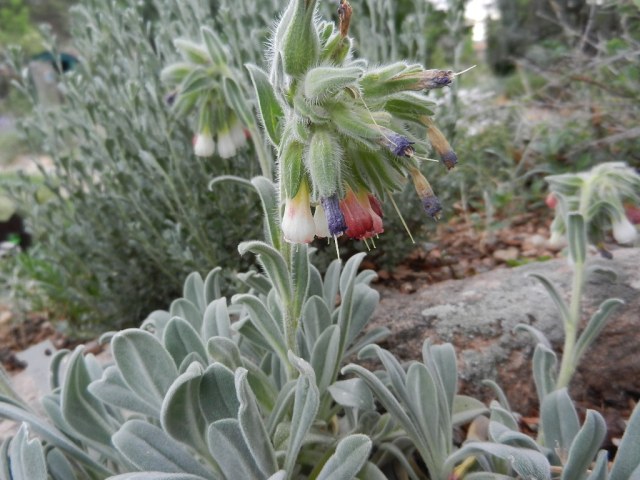
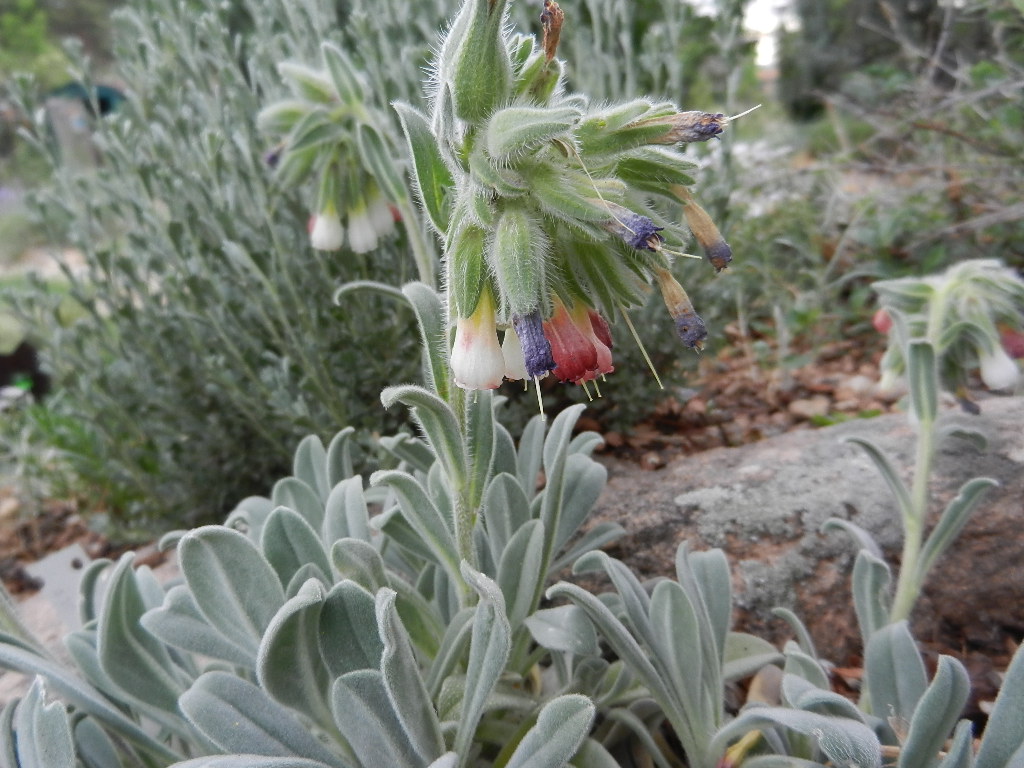
I noticed one of new plants in bloom today: Onosma caerulescens. It isn’t quite the same as the brunfelsia, but the flowers open cream-colored, fade to red, then to purple as the calyces dry up. My version of yesterday, today, and tomorrow.

 the miserable gardener