after the morning walk

The completed path. All that’s left is to “puddle in” some of the soil around the flagstones so that they don’t wobble.
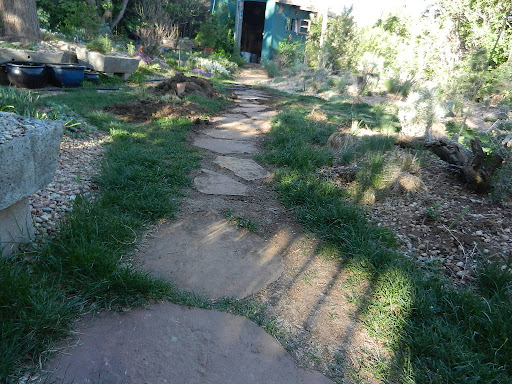
This is the first phase of a multi-phase operation that will involve replacing what’s left of the green lawn with native grasses.
The dog runs out to the back, this way, to see what’s going on, and all the grass was dead after this last winter, so I figured I’d use some of the flagstone left over from an endless project in back (behind the shed) instead of just having bare earth.
The lawn was originally put in for the dogs to play on, but now that there’s only one dog, and only me, I’d rather see blue grama and buffalo grass than this lurid green stuff. I find the green color to be visually upsetting in a garden not overly given to greenery; the ‘609’ buffalo grass which was here back in the 90s (until most of it died, winter of 1999-2000) was a whole lot easier on the eyes.
Now that there are better varieties of buffalo grass for my climate, like ‘Cody’, I know what to do.
I know what not to do, too. Kill the lawn and then seed over it (or plug it), for one thing. The bluegrass in the present lawn (it’s a mix of ryegrass, fescue, and bluegrass) will just come back in a few years, and I don’t feel like fighting that any more than I feel like spraying in the first place.
You scrape off the sod, and find a good place in the garden to dump it. (The lawn isn’t big enough to require a sod-cutter.) The sod is chemical-free so that’s no problem.
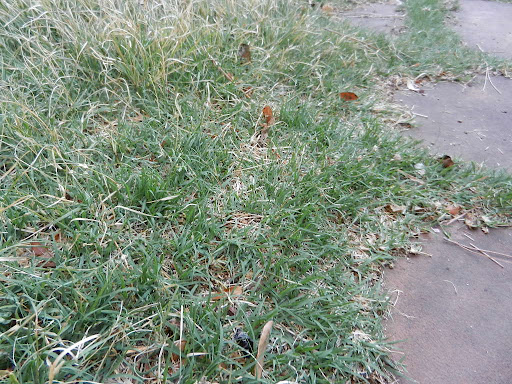
Here’s a shot of, I think, ‘Sharp’s Improved’ buffalo grass growing in the side yard, taken this morning, too. If you ask me, this is the right color for turf in Colorado.
Posted in Uncategorized | Tagged | Comments Off on after the morning walk

later that same day …

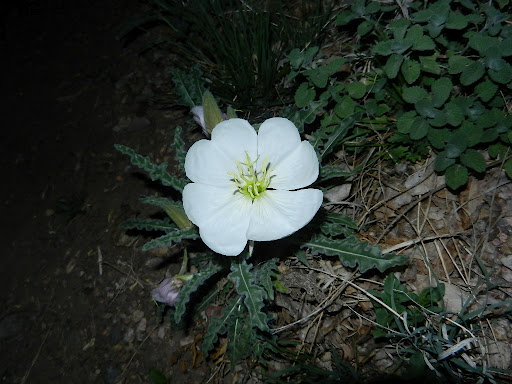
Ventured out to take not-quite-the-first picture of Oenothera caespitosa. Tried the “night portrait” setting on the Coolpix, but the dog was excessively interested in the idea of taking pictures at twilight, so they all came out blurry.
Had to resort to the flash, with the dog inside busy with a chew stick so he wouldn’t see what was going on (the flash looks like lightning to a border collie). The flowers open at sundown, and wither to pink by the next morning (one visible at lower left), unless the morning is overcast. Scented of lemon, the flowers are pollinated by hawkmoths, one of which, Manduca quinquemaculata, is the tomato worm. (My wife never allowed me to dispatch tomato worms…something I don’t do anyway….because the moths are so elegant. Much larger than the typical sphinxmoth, Hyles lineata, they can be mistaken for small birds flying at night.)

While I was trying to hold the camera still, there was what I thought was an overly loud rustling in the little brush pile off to the left, which disturbed me a little.
According to the monograph on this species, published by Missouri Botanical Garden, five subspecies are recognized. I figure this is subspecies caespitosa, though I have grown all of them at one time or another, courtesy of the late Jim Archibald’s seed catalog. My favorite was the extra-tiny subsp. crinita, which met its end in the garden here when I thought it was a good idea to dig it up and move it somewhere else.
Seed dispersal is done by ants, a process called myrmecochory (as with snowdrops, cyclamen, crocus, etc.), and also by rodents. I have plenty of ants, and more than plenty of rodents. Apparently mice eat the seedpods, which is less than desirable, since self-sown plants get their roots right the first time, which isn’t always true with plants grown in pots. But you have to start somewhere.

Posted in Uncategorized | 2 Comments