
Hello again everyone; yes, it is I, Chess the purebred border collie, here to tell you all about our day in the garden. You may remember me from such dazzling posts as “Where We Live” and “As Above, So Below,” among so many, many others.
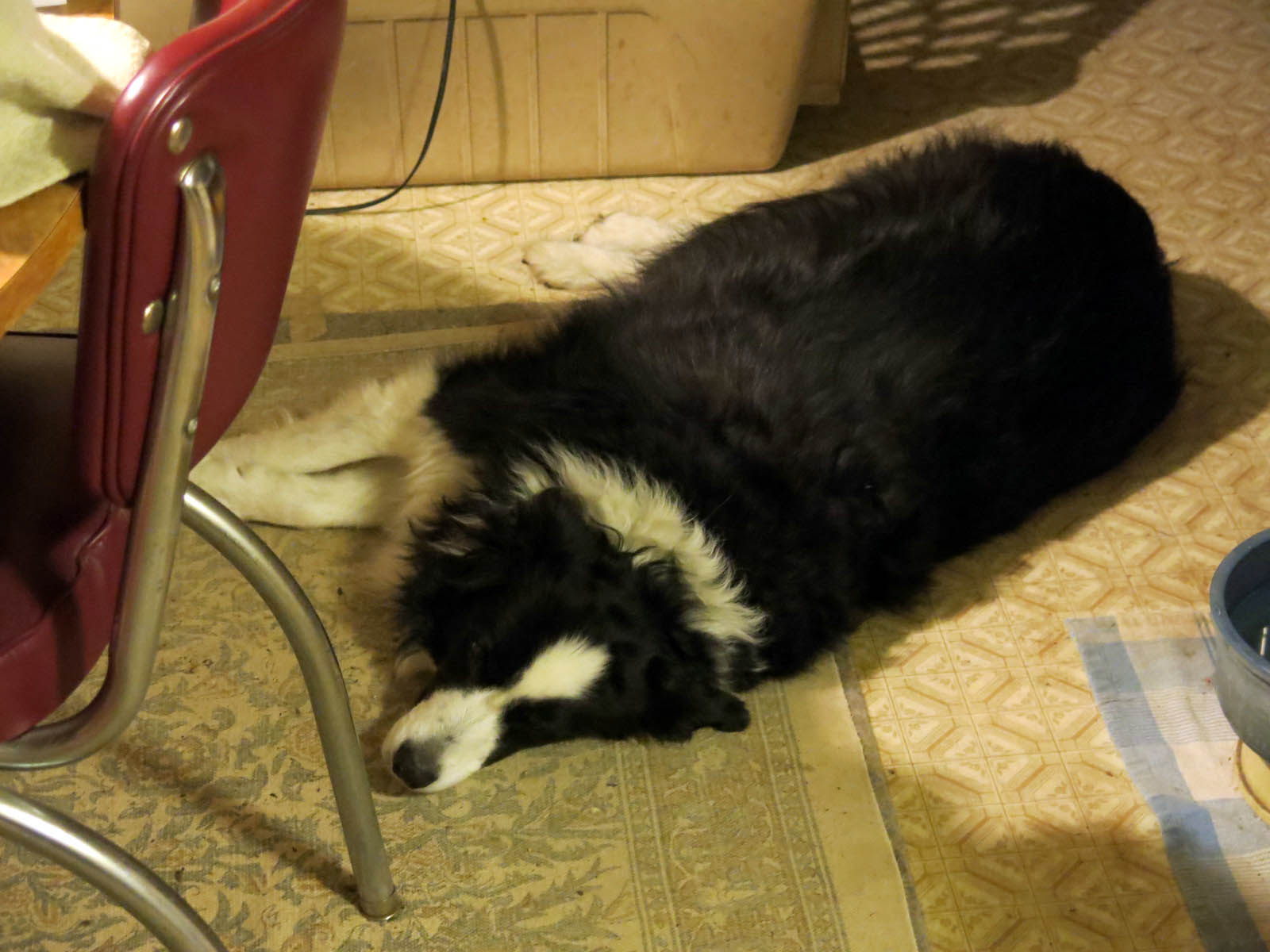
Here I am in a characteristic pose, starting to slip on the kitchen floor, which was not made with the paws of a purebred border collie in mind.

I didn’t slip, if you were worried.
Anyway, today I wanted to show you how the guy I live with makes his portable seed frames. I could really call them pot frames, because they’re made to hold pots, but seed frames sounds better, and that’s what we call them.
I won’t show you how to saw wood or measure stuff, or how to drill wood either, but just show you what they look like. He made another one today since he hadn’t done anything all day except take me on my walk, and he thought it might be high time to make a useful post instead of just showing pictures of whatever he decided to take pictures of.
Here’s the finished seed frame, made from whatever wood he could scrounge. All it has to be as big as is whatever kind of flats are going inside it, and technically, you don’t even have to use flats, but supposedly it’s a good idea.
 Here, he used hardware cloth, because mice can’t get through hardware cloth like they could chicken wire, but you can use chicken wire instead. Or even screen door screen. (Though with screen sometimes the snow doesn’t penetrate, which you want it to do.)
The rope handle is so the frame can be lifted on just one side. (See how he plans ahead, unlike the people who added the extra patio slab, before the guy I live with and my mommy moved into the house, without adding any expansion joints, and the concrete cracked after the winter of 06-07.)
Here it is, where it will probably go. I mean, it went here, obviously, but where it will go for the winter. You want the snow to be able to get onto the pots, to keep them snug, and to be kind of like real life. This practice is called vernalization. It’s isn’t the same thing as stratification, though people do often get them mixed up, like people sometimes think I’m an Australian shepherd when I’m a purebred border collie.
Notice two choices of flat. The one on the left is a regular flat, but about half way down on the right side, it’s been cracked all the way to the bottom, deliberately. Water has to be able to drain out; you don’t want the pots sitting in water all winter long. Ice is okay, but when it comes time to melt, the water has to go. That’s why the choice of flat on the right is even better.
This frame holds three standard flats with a little left over. If you don’t fill a whole flat, the guy I live with suggests putting something against the pots, like rocks or whatever, to keep the pots from falling over. That is, if the pots are round, which his are.
 The ultimate location for the seed frame should be in a place where the pots are fully exposed to sun in April, May, and June; this is the main time when seedlings start to emerge, though some will also emerge later in the year, even as late as October and November. Usually pots can be left over for a couple of winters, even with seedlings growing in them.
Full exposure to sun means that the young plants are now growing in the same environment they’ll be in when they’re in the garden, and there’s less chance of them dying two days after they’re planted than if they had been grown in too shady a place.
Anyway, now we’ve made a useful post. We might be even more useful and show what he’s planning to do with the salt shakers if he ever gets around to it. He says it was all my fault that we didn’t get up until quarter of ten this morning, when there were so many things to do.
I hope you enjoyed this useful post, and now I think I’ll get back to what I do best.
 Until next time, then.







 the miserable gardener