four o’clocks at eight o’clock

The Colorado four o’clock, Mirabilis multiflora, blooming in the yard next door, at eight o’clock. This could have been a better picture but the photographer is a notoriously lazy person.
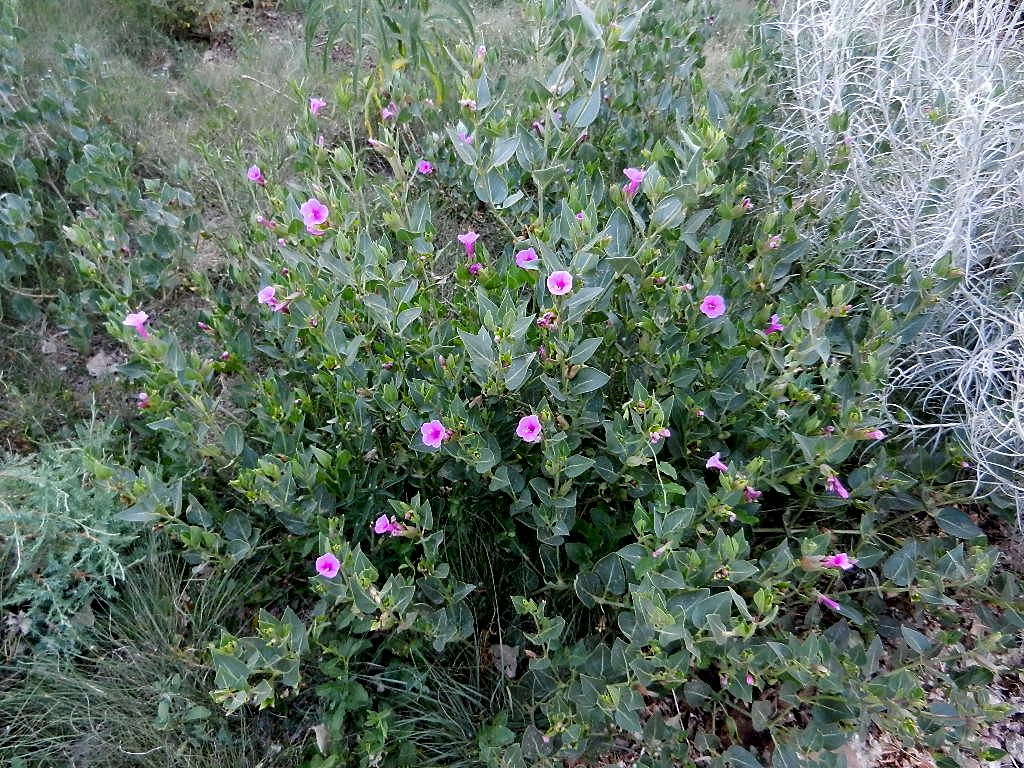
I planted three of these in 2010 and they have been very happy there. By horrible contrast, only one has done as well in my garden, and it’s a much older plant. Why, oh why? Is there no justice in the world?

It can’t be the quality of the help, because both gardens are managed by me, and all I do to the plants is look at them. Maybe I look longer at the ones next door. That must be it. I’ll start standing on the sidewalk in front of my house, looking at my plant, and see what happens.

I’ve tried growing this from seed, with no results, yet shaking the dried stems here and there has resulted in numerous seedlings. Next door, of course; not in my yard.

In Colorado Flora: Western Slope, Weber distinguishes between this species and Mirabilis glandulosa, saying of the latter, “the heavily rose-scented flowers open in early morning”. Why on earth don’t I grow this? Though most taxonomists consider glandulosa to be a subspecies of multiflora, the fact that the flowers open in the morning make this decision slightly suspect. A four o’clock that opens in the morning? Not a species in its own right? That’s just plain weird, if you ask me.

I am trying (that is, hoping it doesn’t die) Mirabilis alipes, which has somewhat larger flowers, white to pink. I have high hopes. At least my neighbor can’t have better plants of this one.
Posted in Uncategorized | Tagged , , , | Comments Off on four o’clocks at eight o’clock

the red one

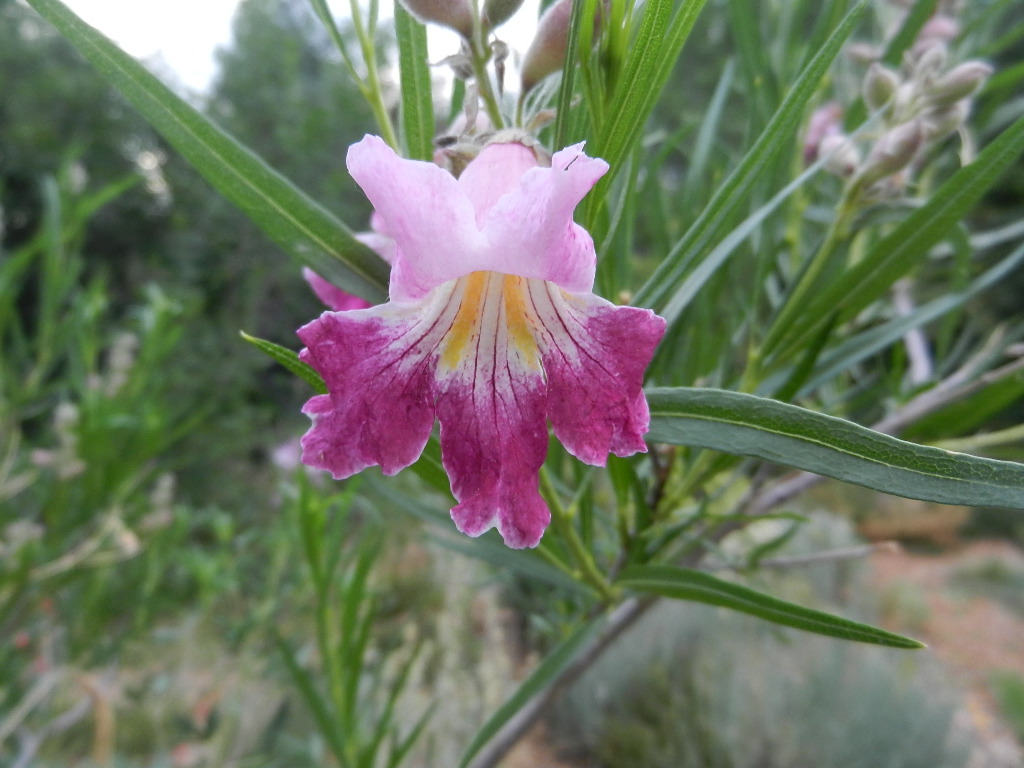
Really, it’s red violet, or close to that. If I had the Royal Horticultural Society Color Chart (only $270 ….) I could be more precise; but red, definitely not.

This is new to the garden, grown from wild-collected seed and purchased as a plant from Timberline Gardens. I also snagged a pure white one, but it was a small plant, and passed away during the winter.

Otherwise the desert willow, Chilopsis linearis, has been completely hardy here; I have six or seven. There are always some dead twigs after a hard winter but the plants regrow so quickly, as much as six feet a year, even with zero irrigation.

I worked outside all day yesterday in 96 degree heat (but only eight percent humidity), so I didn’t feel like doing much today, and don’t have anything fascinating or brilliant or hilarious to say about this plant, but will quote at length from A Natural History of Western Trees by Donald Culross Peattie, who called it the Desert Catalpa. (You …..yes, you, if you’re reading this….are crazy, if you like trees and don’t own this wonderful book.)

“….this modest little tree occupies a vast tract of the West as it is in our times. Call it a world of harsh contrasts, filled with wind and drought, heat and cold. But here this drought-resistant little tree holds its own remarkably well. It is even able to utilize the gusts of the desert that sear the land and make it uninhabitable for many trees with great reputations; for on the winds go sailing, from the Desert Catalpa’s opened pods, the tiny seeds that are flat and light as bits of confetti and borne on silken wings. Thus they cross vast arid spaces, to populate the sands of other waterless washes, the cobbles of other arroyos. Swiftly the new seedlings spring up, enduring as readily as a Papago the long blazing summer days that know no shade until, from the lunar and jagged ranges, the sundown shadows rush forth across the long bajadas to the edge of the world. When the summer stars come forth, and hot Antares blazes in the Scorpion, then and only then there steals forth from the lips of the Desert Catalpa’s blossoms the odor of sweet violets.”

Posted in Uncategorized | Tagged , , | Comments Off on the red one