the last empty space

It isn’t quite the last empty space, but the other two spaces are the corners of the back yard, where wood and branches and dead plants are piled, and there might be spiders there, so I pretend those places don’t exist.

I posted a picture of this back in June, when it was filled with junk after the fence was put up, and now it’s all raked clean and ready for planting. The required implement is in the picture, too. What fun.

This is the first thing people see when they come through the gate; it used to be part of the North Border, which is mostly horrible alkaline subsoil trucked in from hell when the neighborhood was built and the excellent creek bottom loam was scraped off, never to be seen again. The actual subsoil is reddish, like Red Rocks a couple of miles to the west, probably decomposed sandstone, and reasonably easy to dig in even when dry ….but you have to dig to get to that.

Not only is the soil awful, it’s been hard packed by dog paws, since the chain link fence offered a good view of whatever border collies think is a good view, and years of running down the gravel path have turned this into a conglomerate of hard packed awful soil and pea gravel.

My garden staff is nowhere in sight, the dog is no use at all (he expects me to cut a hole in the fence so he can see through), and soil, no matter how awful, doesn’t dig itself.

Time to get to work on this. After my nap, of course.


Posted in Uncategorized | Comments Off on the last empty space

pinery irony

My interest in the single-leaf piñon, Pinus monophylla, probably started when I read Graham Stuart Thomas’s Three Gardens (one of my favorite gardening books) and wondered why it was that this pine was unavailable in the nursery trade in North America. After all, it’s native to the Great Basin, California, Arizona, Baja California, and so on. It will grow with about six inches of annual precipitation (grow slowly, that is). It’s similar to the regular piñon (Pinis edulis) but bluish, with single needles; the nuts are edible as well.

For a long time it was thought that the single needle was really two needles fused as one (because Joseph Dalton Hooker said so, and he worked at Kew, and that was that) but research, described in Lanner’s The Piñon Pine (another terrific book), showed that the growth of the second needle in the fascicle was suppressed by a mutation.

So they grow this totally cool pine in England, but not here.

You would think with all this supposed interest in saving water that everyone would want at least six of these, but, still, try finding one. I was lucky enough to get one many years ago, and it has endured everything that Denver’s weather can throw at it, including being completely knocked out of the ground in the March blizzard of ’03. (I replanted it and it took off, like a snail.)

Pinus monophylla

Peattie (A Natural History of Western Trees) says “The growth of this tree is painfully slow. A tree with a stem only 6 inches in diameter has already seen a century of arid seasons pass, and still its life course may not be half run. In youth the short thick trunks are capped by pyramidal crowns of rather straight and uplifted branches. An ancient Nut Pine, however, is almost unrecognizable, in shape, as the same thing, for the crown has become short and flat, and the branches are all twisted and bent low, and the years will but add to the gnarled look of this manna tree of the Mohave.”

Okay, there’s the reason no one wants one. It might get ugly in three hundred years.

There are a number of dwarf selections made by Jerry Morris of Lakewood; I had to have as many of these as possible, of course. These are from witches brooms.

Pinus monophylla ‘Blue Jazz’

Pinus monophylla ‘Whoopy’

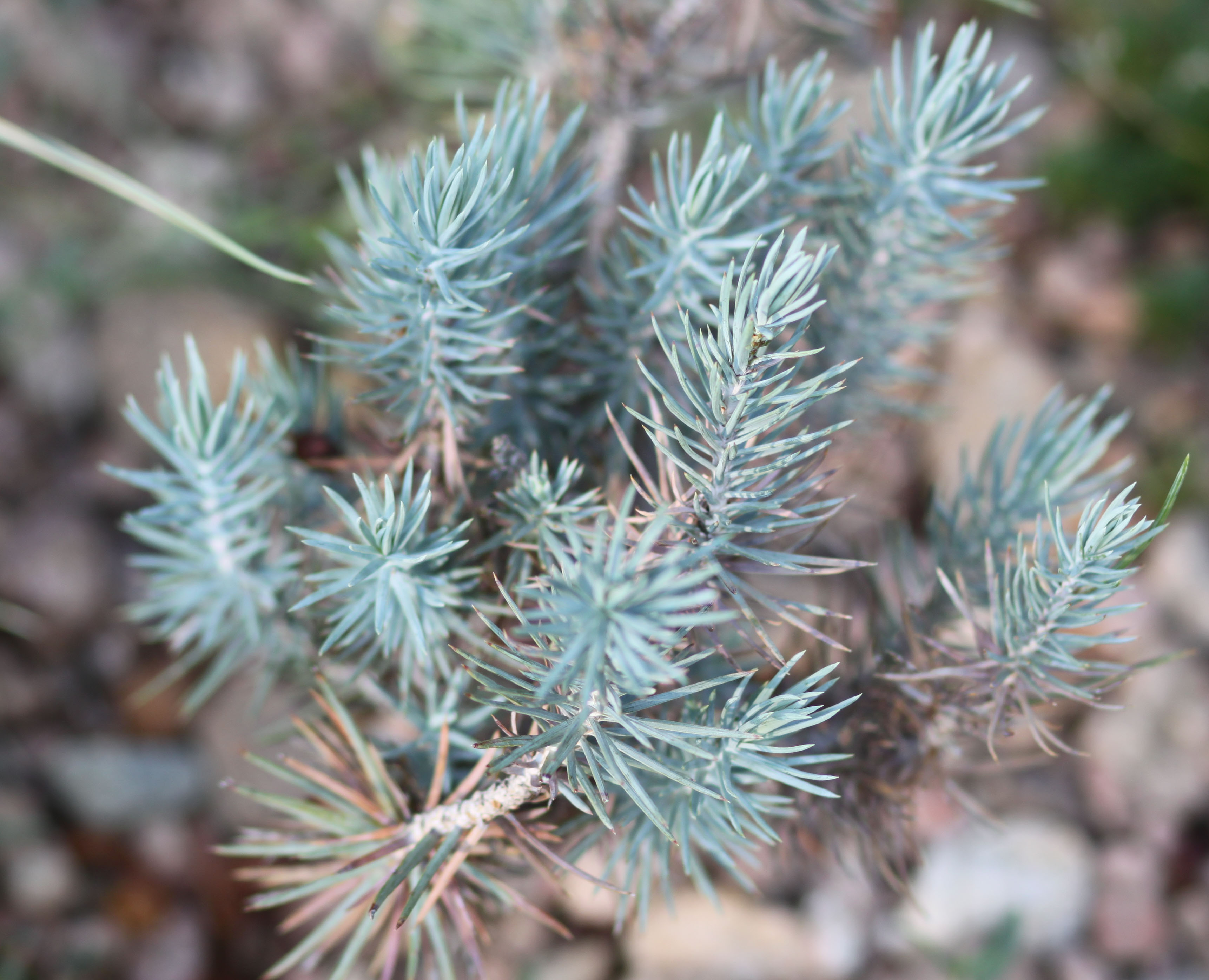
I was also fortunate to get some grown from “broom seed”, that is, seed that the witches broom itself produced. There were some plants in the far corner of Jerry’s nursery that needed a home; I tried desperately not to be a hog and so left one. There are four here, well cared for (really), and are looking pretty good. For now.

Pinus monophylla from broom seed..I know this isn’t so focused

Pinus monophylla from broom seed, doing a weird two-color thing.

Posted in Uncategorized | Tagged , , | Comments Off on pinery irony